

Risk Management · 2025
In this section3 topics
Risk Management Policy & Plan
Policy & Plan Description
The Company places significant importance on enterprise-wide risk management and internal control systems that are adequate and appropriate to the nature of its business operations. This is to enhance operational efficiency, reduce and prevent risks that may cause damage to the Company’s assets, and ensure compliance with applicable laws and regulations. The Company has established a systematic risk management process in accordance with international standards and has integrated such processes into its business operations. A comprehensive risk management policy framework and operating system have been implemented across all business units under the Enterprise Risk Management (COSO–ERM) framework of the Committee of Sponsoring Organizations of the Treadway Commission, together with management system standards issued by the International Organization for Standardization
The Company has been certified under multiple international management systems, including
ISO 9001 (Quality Management System),
IATF 16949:2016 (Automotive Quality Management System),
ISO 45001 (Occupational Health and Safety Management System),
ISO 14001 (Environmental Management System).
These standards enable the Company to comprehensively identify risks and business opportunities across quality, safety, occupational health, and environmental dimensions. This integrated approach supports effective risk management, ensures that risks are maintained at acceptable levels, creates sustainable value for the organization, and aligns with the principles of Good Corporate Governance.
The company has established a risk management structure, including the **Risk Management Committee**, responsible for setting risk management policies and frameworks for the corporate group. This committee oversees supports risk management efforts to achieve objectives. Additionally, the **Executive Risk Management Committee** is responsible for risk assessment, risk management planning, and overseeing risk control at the organizational level. This committee also reviews risk management processes to ensure they are adequate and maintain risks at an acceptable level.
The Board of Directors has established an independent Internal Audit function, separate from the Risk Management function, with a direct reporting line to the Audit Committee. Ms. Chayanee Chaidechkhachorn, Assistant Director of the Internal Audit Department, is responsible for overseeing the Company’s internal audit activities at the operational level.
The Internal Audit function reviews internal management processes and evaluates the effectiveness of the Company’s internal control and risk management systems to ensure operational efficiency, effectiveness, and alignment with Company policies. Audit results are reported quarterly to the Audit Committee and the Board of Directors to assess the adequacy and appropriateness of the internal control system.
Policy Document Link
https://investor.kce.co.th/storage/sustainability/corporate-governance-policy/policy-and-procedure/20260209-kce-corporate-risk-management-en.pdf
Risk Factors — Overview
Risk Factors — Introduction
KCE Electronics Public Company Limited is committed to achieving its goal of being a leading **PCB (Printed Circuit Board) manufacturer** globally. Risk management is an integral part of all business processes. The company has established various risk management committees to assess risks in all areas, ensuring a clear risk management direction aligned with business strategies and objectives under a good governance framework.
Risk Management Structure
The company and its subsidiaries implement a systematic and integrated risk management approach alongside strategic planning to ensure continuous risk management across the organization. The following risk management structure has been defined.
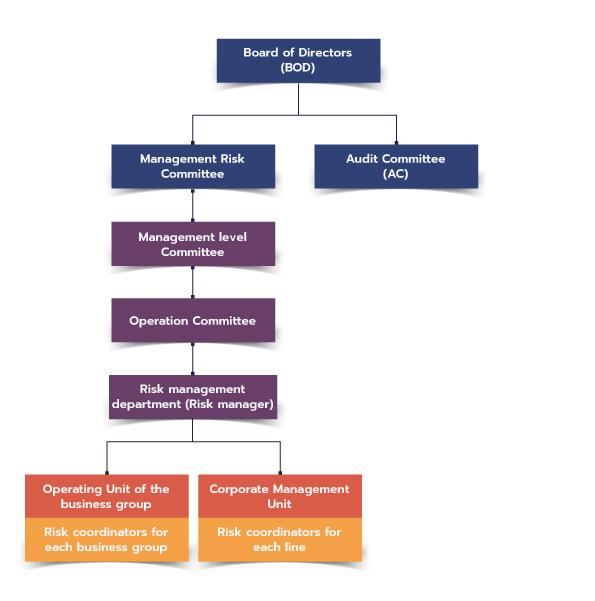
Enterprise Risk Management Policy Committee Responsible for defining overall risk management policies, ensuring comprehensive risk coverage, and proposing these policies for board approval. This committee identifies key risks, suggests preventive measures, and continuously monitors risk mitigation plans to adapt to business conditions. Quarterly reports are submitted to the Board of Directors.
Executive Risk Management Committee Evaluates risks, formulates, and oversees risk management plans at the corporate level. It ensures alignment with risk management policies, monitors implementation, and assesses the effectiveness of risk management frameworks.
Operational Risk Management Team Collects data for risk assessments, develops risk management plans at the departmental level, assigns responsibilities, and monitors risk management implementation in line with company policies.
Audit Committee Reviews and assesses the internal control and corporate risk management systems to ensure efficiency and alignment with company policies. Quarterly reports are submitted to the Audit Committee and the Board of Directors.
Risk Management Culture
The company emphasizes fostering a risk management culture throughout the organization by establishing a solid corporate governance foundation. The **Board of Directors and executives** actively support and closely monitor risk management efforts. Risk management awareness is instilled at all employee levels through communication, education, and integration into corporate culture. Additionally, risk management performance is incorporated as a key performance indicator (KPI) for **risk owners** and management-level employees. The company also considers risk management a core factor in developing innovations, products, and services.
Risk Assessment
The company identifies and analyzes risks by assessing the **likelihood** and **impact** of events. Risk management plans and mitigation measures are developed based on severity and potential consequences. The company also reports and reviews risk management performance regularly.
Risks to the Company's Business Operations
Risk Register
| Risk Name | Risk Characteristics | Consequences | Management Measures | Related Risk Factors | ||||||||
|---|---|---|---|---|---|---|---|---|---|---|---|---|
| Strategic Risk |
|
Due to global economic uncertainties (inflation, geopolitical risks, the Fed’s interest rate cut policies, central banks’ gold purchases, demand for AI and clean energy, as well as increasing demand from China), raw material prices have risen significantly. Indicator: % increase in raw material prices
The global economy shows signs of recovery but remains fragile due to economic slowdowns in the U.S., China, and Europe. Major risks stem from uncertainties in global trade policies (tariff wars) and geopolitical tensions. Industry competition is also intensifying, particularly in the automotive sector, which is the Company’s main customer group and is transitioning to electric vehicles (EVs). This transition has rapidly changed customer demand, with greater emphasis on cost and technological competitiveness, potentially affecting the Company’s operating performance. Indicator: Sales proportion by product category. : Sample job ratio – Automotive vs. Non-Automotive
The electronics industry experiences rapid technological changes in manufacturing processes, which may pose risks to competitiveness. The Company continuously invests in new production technologies and develops products and manufacturing processes to accommodate increasing product diversity. Emphasis is placed on quality control processes to meet customer requirements, particularly for HDI (High Density Interconnect) products, which require advanced manufacturing technology. Indicator: Capital investment in new machinery to accommodate advanced technology. |
The Company has implemented risk management measures to mitigate the impacts as follows: 1.1 Internal cost reduction through company-wide cost-saving initiatives. 1.2 Sourcing alternative raw material suppliers to reduce reliance on materials from China. 1.3 Identifying and onboarding new raw material suppliers as alternatives. 1.4 Improving raw material inventory management.
The Company has implemented the following measures to mitigate the impacts: 2.1 Expanding into additional customer segments such as Industrial and Telecommunications groups. 2.2 Enhancing raw materials and product quality through the adoption of advanced technology and automation systems. 2.3 Continuously monitoring customer demand to identify new business opportunities and develop new products.
The Company has implemented the following measures to mitigate the impacts: 3.1 Studied and implemented higher-technology processes such as Back Drill, Copper Inlay, ELIC (multiple layer drilling), Metal Core, etc. 3.2 Introduced new materials such as Conductive Ink, Hydrogen-Free Laminate, and Heavy Copper 6Oz to support future advanced applications. 3.3 Sent employees to study and observe new technologies abroad, such as in China and Japan. | 728 · Description: Volatility in the industry in which the company operates · Info category: STRATEGIC_RISK · 732 · Description: Changes in technologies · Info category: STRATEGIC_RISK | ||||||||
| Operation Risks |
|
Currently, the Company has HDI orders exceeding its production capacity. As a result, there are outstanding orders pending delivery to customers. This may lead to customers imposing late delivery penalties on the Company, or the Company may incur additional expedited shipping costs to meet customer deadlines. Indicators: Outstanding orders pending delivery Increased freight costs compared to normal rates
2.1 The Company emphasizes compliance with the Personal Data Protection Act (PDPA), including proper collection, storage, and destruction of personal and sensitive company data, to prevent data breaches that could cause damage to the Company. Indicator: Number of data breach incidents 2.2 Human Rights and Labor Law Compliance Risk: Compliance with labor laws regarding employee working hours to ensure they do not exceed legally permitted limits. Indicator: Number of employee complaints 2.3 Succession Planning Risk: The Company currently has several senior executives who have reached retirement age, and there is a risk arising from the absence of a clear succession plan. Indicator: Number of employees enrolled in the successor plan.
Currently, climate change has become increasingly severe and volatile, which may lead to risks from natural disasters such as fires, floods, earthquakes, and other extreme events that could impact business operations, assets, and employee safety. Climate Change Risk Indicators (Abbreviated) :
|
The Company has implemented the following measures to mitigate the impacts: 1.1 Investing in additional advanced machinery to support HDI production capacity. 1.2 Aligning production planning with customer orders to control costs at an acceptable level. 1.3 Improving production processes to align with new technologies in order to reduce defect rates (damage) and shorten production lead time. 1.4 Strengthening preventive maintenance programs to reduce machine downtime.
The Company has implemented the following measures to mitigate these risks. 2.1 Providing training on the Personal Data Protection Act (PDPA), establishing a PDPA Committee, and appointing a Data Controller responsible for overseeing access, storage, and destruction of personal data to prevent data leakage and potential damage to the Company. 2.2 Mitigating labor law compliance risks by implementing a computerized system to control and approve employee overtime in accordance with legal requirements. 2.3 Developing a formal succession plan by clearly defining qualifications and criteria for each key position, recruiting candidates from both internal and external sources, and extending the retirement age for certain positions where no suitable successor has yet been identified.
3.1 The Company and all its subsidiaries have mitigated potential risks by obtaining comprehensive insurance coverage, including All Risk Insurance and Business Interruption Insurance, from financially strong insurance providers to reduce exposure to potential losses. The Company also reviews its insurance policies annually to ensure that coverage limits remain appropriate and sufficient to cover potential damages in all circumstances. 3.2 The Company has established emergency response plans, such as fire evacuation plans (with drills conducted annually). In the past year, following the earthquake incident in August 2025 (B.E. 2568), the Company enhanced its earthquake response plan to strengthen preparedness and build greater confidence in the event of a similar occurrence in the future. | 755 · Other name: Production Output Risk · Description: Other · Info category: OPERATIONAL_RISK | ||||||||
| Financial Risks |
|
In 2025 (B.E. 2568), the appreciation of the Thai Baht has impacted the Company, as more than 90% of its total sales are generated from exports to overseas markets. As a result, the majority of the Company’s sales revenue is denominated in foreign currencies, primarily U.S. Dollars. Meanwhile, part of the cost of sales arises from the import of raw materials from abroad. Therefore, fluctuations in the Thai Baht exchange rate may significantly affect the Company’s costs, expenses, and overall operating performance. Indicator: Percentage change in the Thai Baht exchange rate (%)
Due to the slow economic conditions that have not yet fully recovered, the company is concerned about each customer's ability to repay their debts. If customers are unable to meet their payment obligations, it may negatively affect the company's liquidity. Indicators: Customer credit ratings Aging analysis report of overdue receivables |
The Company continues to implement hedging policies to mitigate risks arising from exchange rate volatility through the following approaches: 1.1 Managing foreign currency revenues and expenses in the same currency (Natural Hedge) to create a balance between foreign currency-denominated assets and liabilities. 1.2 Utilizing financial derivatives, such as Forward Contracts, to hedge the net exposure arising from differences between foreign currency-denominated assets and liabilities.
The Company has implemented the following measures to mitigate the impacts of such risks: 2.1 Closely monitoring the payment performance of each customer. 2.2 Reviewing customers’ financial status through reputable institutions such as Moody’s Ratings, S&P Ratings, and Fitch Ratings | 764 · Description: Fluctuation in exchange rates, interest rates, or the inflation rate · Info category: FINANCIAL_RISK · 1724 · Description: Liquidity risk · Info category: FINANCIAL_RISK | ||||||||
| Information Technology Risk |
| Damage to or disruption of the main servers, core databases, and communication network systems whether caused by cyberattacks, system failures, or natural disasters may result in production interruptions and disruptions to business continuity. Such incidents could also lead to the loss of critical machine and production data or unauthorized access to sensitive business information, potentially causing operational and reputational damage to the Company Risk Indicators:
| The Company places great importance on this matter and has implemented the following measures:
| 737 · Other name: IT Security Risk · Description: Other · Info category: STRATEGIC_RISK | ||||||||
| Emerging Risk |
| Risk from International Conflicts and Global Economic Slowdown International conflicts have led to a significant increase in global energy prices, resulting in higher costs of raw materials, supplies, and expenses related to transportation and production. In addition, rising energy prices have contributed to inflationary pressures in many countries, causing a slowdown in global economic growth and a decline in consumer purchasing power. This may lead to a reduction in customer order volumes and adversely affect the Company’s revenue and operating performance. Indicator: Order volume | The company has implemented a systematic risk management approach by formulating strategic production plans aligned with order volumes and market conditions. This enables the company to manage operations effectively and remain flexible in response to changing circumstances. The company focuses on maximizing machinery capacity utilization while investing in and adopting modern manufacturing technologies to enhance efficiency, reduce losses, and maintain production costs at an appropriate level. These measures help strengthen the company’s competitiveness and ensure long-term operational stability. In addition, the company places great importance on maintaining close communication with overseas customers through its sales offices to continuously monitor order status and respond promptly to any changes. | 737 · Other name: Economic downturn risk · Description: Other · Info category: STRATEGIC_RISK | ||||||||
| Environment, Social and Governance |
|
Climate change is a critical global issue that significantly impacts the environment, economic systems, and the quality of life worldwide. Many countries have therefore prioritized urgent collaborative actions to reduce greenhouse gas emissions. Thailand has announced its commitment to achieving Net Zero Emissions by 2065 (B.E. 2608). At the same time, the Company has received requirements from customers to participate in reducing greenhouse gas emissions in alignment with their sustainability targets. Accordingly, the Company places great importance on managing and adapting to climate change-related risks in order to maintain its competitiveness and ensure the continuity of customer orders in the long term. Indicator: Amount of greenhouse gas emission reduction (Carbon Emission Reduction)
Causes of Human Rights Risks
Otential Impacts
Key Performance Indicator (KPI): Number of Employee Complaints.
The Company places great importance on good corporate governance and is committed to conducting its business in strict accordance with corporate governance principles. The Company ensures that its operations are carried out with transparency, accountability, and compliance with its policies, as well as applicable laws and regulations, including the Corporate Governance Code of the Stock Exchange of Thailand (SET). This commitment aims to build confidence among all stakeholders, including shareholders, customers, employees, and the general public. |
The Company has established and continuously implemented measures to reduce greenhouse gas (GHG) emissions as follows: 1.1 Develop and implement Carbon Footprint of Product (CFP) assessments to analyze and manage greenhouse gas emissions throughout the value chain. 1.2 Promote the use of renewable energy by installing rooftop solar power systems with a total installed capacity of 3.4 megawatt-peak (MWp) for internal consumption. 1.3 Enhance production efficiency and technological innovation to improve operational processes, reduce energy consumption, and minimize resource losses. 1.4 Encourage and raise employee awareness to adopt energy- and resource-efficient behaviors for optimal and sustainable utilization.
Human Rights Risk Mitigation Measures 2.1 Establish clear policies and guidelines: Develop human rights and labor policies in line with applicable laws and international standards, and communicate them to employees and business partners. 2.2 Conduct Human Rights Due Diligence: Regularly assess and monitor human rights risks across the organization and supply chain, and implement preventive and corrective measures. 2.3 Provide secure grievance mechanisms: Ensure accessible and confidential complaint channels, with protection against retaliation for whistleblowers. 2.4 Ensure fair investigation and remediation processes: Implement transparent investigation procedures and provide appropriate corrective actions and remedies. 2.5 Provide training and awareness programs: Conduct regular training for employees and management on human rights, non-discrimination, and ethical conduct. 2.6 Monitor and report performance: Track key indicators such as the number of complaints and resolution time, and report progress to management on a regular basis.
The Company has established clear anti-corruption and anti-bribery policies and guidelines, which are communicated to employees and stakeholders to ensure awareness and compliance. In addition, the Company conducts an annual corruption risk assessment and review to implement appropriate control measures in alignment with the requirements of the Thai Private Sector Collective Action Against Corruption (CAC). | 1719 · Description: Climate change and disasters · Info category: STRATEGIC_RISK · 753 · Description: Impact on human rights · Info category: OPERATIONAL_RISK |