

Board Performance · 2025
In this section15 topics
- Compliance Monitoring — Overview1 item
- Prevention of Conflicts of Interest3 items
- Prevention of the Use of Inside Information3 items
- Anti-Corruption5 items
- Whistleblowing4 items
- Selection of Directors & Chief Executives6 items
- Selection of Independent Directors2 items
- Director Development2 items
- Evaluation of Board & Subcommittee Performance3 items
- Subcommittees2 items
- Meeting Attendance & Remuneration5 items
- Supervision of Subsidiaries & Associated Companies4 items
- Board Duty Performance — Overview1 item
- Audit Committee Duty Performance2 items
- Executive Committee Duty Performance1 item
Compliance Monitoring — Overview
Monitoring of Compliance with Other CG Policies & Guidelines
Disclosure and Transparency
The Company recognizes the importance of information disclosure because it greatly affects decision-making by investors and stakeholders. The Company discloses accurate and complete corporate information, both financial and non-financial, as specified in relevant regulations in a timely and transparent manner through various channels, such as through the SET Community Portal (of the Stock Exchange of Thailand), Annual Report (56-1 One Report), as well as via the Company’s website (www.kce.co.th) (Thai and English) to ensure a factual presentation of vital information and transparent business practices. The Company distributes the annual report, financial statement and information explaining features of the Company’s performance in the previous year to Shareholders annually at the Annual General Meeting of Shareholders.
The Company has established policies in regard to external communications as recommended by the Principles for Ongoing Disclosure and Material Development Reporting by Listed Entities to be practiced by staff members, as follows:
The Company strives to give all parties equal treatment consistently within the set framework by avoiding favoritism or situations where conflicts of interest may arise.
Dissemination of the Company’s information will be made clearly, accurately and transparently. The information is to be credible and straightforward and distributed to stakeholders in a clear, easily understood, and timely manner.
The Company ensures that any release of information will not jeopardize client relationships, or breach regulations concerning confidential information of clients, Shareholders or other stakeholders.
The Company’s employees must follow the Company’s code of conduct where sensitive information is involved
Spokespersons for the Company concerning sensitive information are limited to the Chairman of the Board. The managing Director, a Director, or an executive can be designated by the Chairman of the Board to act as a spokesperson to release information about selected important issues
The Company emphasizes disclosure of information by consistently adhering to the principle of transparency, fairness, completeness, promptness and accuracy, as follows:
The Company discloses accurate, complete and timely financial information and non-financial information.
The Board is responsible for the Company’s and subsidiaries’ financial reports, the Board’s statements, and the Audit Committee’s reports are presented in the company’s annual report. All information presented in the financial reports is correct in accordance with generally accepted accounting principles and standards, and has been audited by an independent external auditor and is up to date.
A summary of the Company’s Corporate Governance Policy together with implementation of the policy is presented through various channels such as the Company’s annual reports and the Company’s website (www.kce.co.th)
Remuneration of Directors and executives with the amount of payment that corresponds to the contributions and responsibilities of each person are also disclosed via the Company’s annual reports and the Company’s website (www.kce.co.th)
Disclosure of audit and non-audit fees.
The Corporate Governance report describes the roles and responsibilities of Directors as well as provides the number of Meetings and the attendance of each Director each year.
All Directors are to disclose and/or report their securities trading and holding, connected transactions and the equity, via the Company Secretary; to the Board of Director’s Meeting each quarter.
The Board of Directors specifies the principle for the Company’s directors and Executive managements to report on conflict of interest and related person according to the Section 89/14 of the Securities and Exchange Act B.E. 2551. The report is required to be reviewed each year and/or at the time there is a change, and to be submitted to the Company Secretary.
The Board of Directors provides a policy to prevent the use of internal information acquired by being the directors, executive managements or the employees of the Company, to exploit the benefit for themselves or to enter into a competing business or related business, including the benefit for company stock trading or giving internal information to other party for the benefit of stock trading.
Report on changes in securities holdings of directors and management for the year 2025
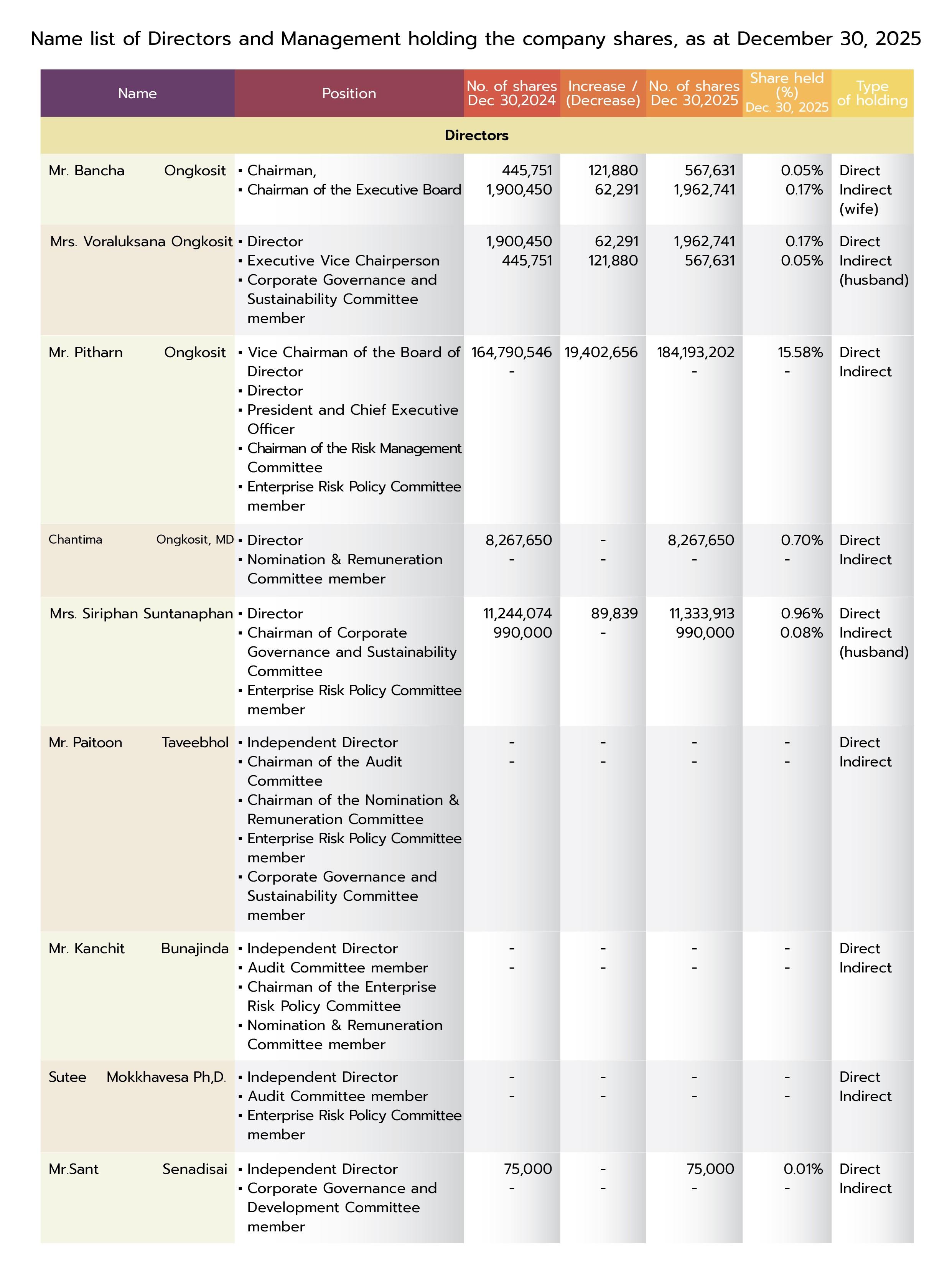
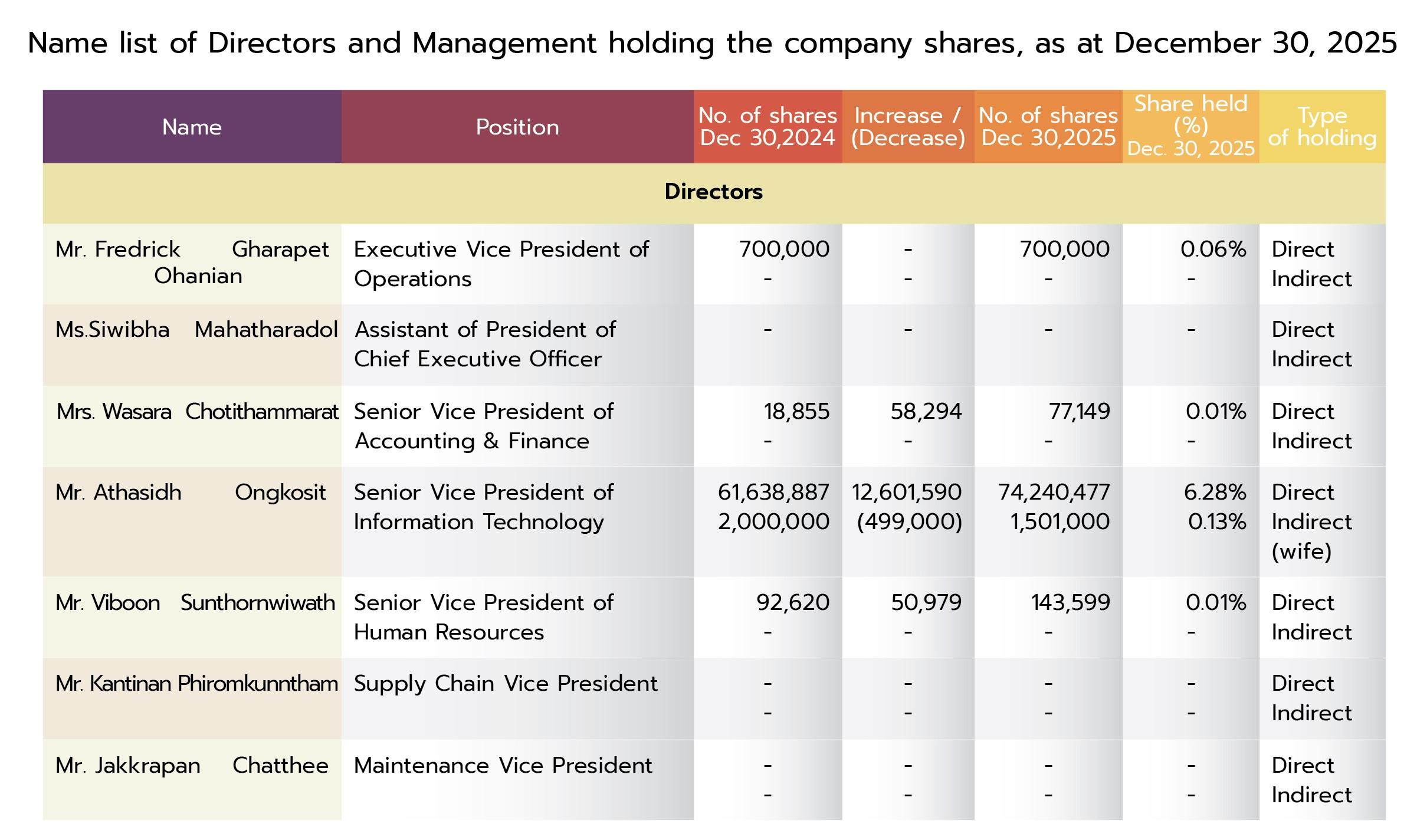
In 2025, no directors or management were found to have traded securities during the period that the company had specified to suspend trading.
Policy on Intellectual Property
The Company acknowledges the importance of intellectual property created from an individual’s knowledge and ability. The Company, therefore, always makes sure that information used in the Company will not violate the intellectual property of others.
The Company does not permit or encourage its employees to use illegal software for any Company business.
Employees who use the Company’s computers must strictly follow the rules and conditions of the manufacturer and only with the permission of the Company.
Employees are not allowed to use any intellectual initiatives created for the Company’s business for personal purposes unless they receive permission from the Company. Employees have to return any intellectual property to the Company as soon as their employment is terminated.
Employees will ensure that external information used for the Company’s business purposes is legal and does not violate the intellectual property of others.
Prevention of Conflicts of Interest
Has the Company Acted to Prevent Conflicts of Interest?
Yes
Operations in the Past Year
The Board of Directors has established a Conflicts of Interest Policy to encourage honesty and transparency in business operations and to prevent inappropriate transactions with related parties. The policy sets standards and guidelines, as well as an approval process for normal business transactions that may have conflicts of interest. In addition, when entering into a major or significant transaction with a potential conflict of interest that affects the Company's business operations, the management must seek prior approval from the Board of Directors.
In 2025, the Company conducted conflict of interest awareness training for directors, executives, and employees through an e-learning platform to enhance understanding and prevent situations that may give rise to conflicts of interest. All employees and executives designated to participate recorded a full participation rate of 100 percent, demonstrating complete compliance with the program requirements. The Company also communicated its Conflict of Interest Policy to all personnel and monitored conflict of interest disclosures submitted by directors and executives, with the results reported to the Board of Directors.
Number of Conflict-of-Interest Cases
| Metric | Current Year | Previous Year | Two Years Ago |
|---|---|---|---|
| Total number of cases or issues related to conflicts of interest (cases) | 0 | 0 | 0 |
Prevention of the Use of Inside Information
Has the Company Acted to Prevent the Use of Inside Information?
Yes
Operations in the Past Year
The Company has implemented strict measures to prevent the misuse of insider information for personal gain and has continuously reviewed and enhanced its corporate governance policies. The Company enhanced its internal control systems and monitoring processes to regulate access to sensitive information. A designated blackout period was enforced for individuals with access to material information, and disciplinary actions aligned with corporate regulations were applied in cases of non-compliance.
The Company provides communication and training to enhance the knowledge and understanding of insider-trading prevention for directors, executives, and employees through an e-learning. This initiative aims to raise awareness and prevent the use of the Company’s inside information for personal benefit or disclosure to unauthorized parties. All employees and executives required to participate in the program completed the training, achieving a 100%.
Throughout the year, no incidents of insider information misuse were reported, reflecting the Company's strong commitment to maintaining the highest standards of transparency and accountability for shareholders and all stakeholders.
Number of Inside-Information Cases
| Metric | Current Year | Previous Year | Two Years Ago |
|---|---|---|---|
| Total number of cases or issues related to the use of inside information to seek benefits (cases) | 0 | 0 | 0 |
Anti-Corruption
Introduction
The Company places strong emphasis on operating with good governance and transparency. Clear policies and measures for preventing corruption have been established, and all employees are encouraged to uphold integrity in their work. Throughout the year, the Company conducted reviews of corruption-related risks across key processes and strengthened internal controls to enhance operational effectiveness. A confidential and traceable whistleblowing channel is also maintained to allow stakeholders to report concerns safely.
Has the Company Acted on Anti-Corruption?
Yes
Operations in the Past Year
Anti-Corruption Measures
The Company provides anti-corruption training as part of the New Employee Orientation program.
The Company provides anti-corruption training through the monthly “KCE Life & Core Value and Anti-Corruption” program for employees.
The Company displays anti-corruption campaign posters in areas that are easily visible to employees, such as the cafeteria, factory walkways, and public announcement boards.
The Company, through the Corporate Governance and Sustainability Committee and the Board of Directors, conducts an annual review of the Anti-Corruption Policy.
The Company disseminates its Anti-Corruption Policy to external parties, which can be accessed via the Company’s website under the Corporate Governance section. https://investor.kce.co.th/storage/sustainability/corporate-governance-policy/policy-and-procedure/20260209-kce-anti-fraud-corruption-policy-en.pdf
The Company disseminates its Anti-Corruption Policy to internal personnel through the Company’s Intranet under the “Corporate Governance” section.
KCE Technology Co., Ltd., a subsidiary of the Company, conducted a corruption risk assessment, identified appropriate control measures, and applied for certification under the Thai Private Sector Collective Action Against Corruption (CAC) initiative. The subsidiary received CAC certification on 30 June 2025.
The Internal Audit Department conducted audits to assess compliance with the Group’s Anti-Corruption Policy, including practices related to receiving or giving gifts, gratuities, and business hospitality.
Form of Anti-Corruption Operations
| Operation |
|---|
| Review of appropriateness in anti-corruption |
| The participation in anti-corruption projects |
| Assessment and identification of corruption risk |
| Communication and training for employees on anti-corruption policy and guidelines |
| The monitoring of the evaluation of compliance with the anti- corruption policy |
| Review of the completeness and adequacy of the process by the Audit Committee or auditor |
Number of Corruption Cases
| Metric | Current Year | Previous Year | Two Years Ago |
|---|---|---|---|
| Total number of cases or issues related to corruption (cases) | 0 | 0 | 0 |
Whistleblowing
Introduction
The Company is committed to fostering a transparent and accountable working environment. To support this commitment, a formal whistleblowing mechanism has been established to enable employees, business partners, stakeholders, and external parties to report any suspected misconduct, fraud, legal violations, or actions that breach the Company’s Code of Conduct. Multiple confidential and easily accessible reporting channels are provided, along with measures to protect whistleblowers from retaliation or negative consequences resulting from their reports.
In addition, the Company has implemented a structured investigation process to ensure that all allegations are assessed fairly, independently, and in a timely manner. Relevant committees and responsible departments review, investigate, and report the outcomes through transparent governance procedures. This system reinforces the Company’s dedication to integrity and strengthens trust among all stakeholders.
Has the Company Implemented Whistleblowing Procedures?
Yes
Operations in the Past Year
Whistleblowing
The Company provides training on anti-corruption practices, including whistleblowing and complaint channels, as part of the New Employee Orientation program.
The Company provides training on anti-corruption practices, including whistleblowing and complaint channels, through the monthly “KCE Life & Core Value and Anti-Corruption” program for employees.
The Company displays posters showing whistleblowing and complaint channels in areas easily visible to employees, such as the cafeteria, factory walkways, and public announcement boards.
The Company, through the Corporate Governance and Sustainability Committee and the Board of Directors, conducts an annual review of the Fraud Risk Management Manual, which outlines procedures related to whistleblowing mechanisms.
The Internal Audit Department reports to the Audit Committee on a quarterly basis on any complaints received through the Whistleblower channel.
The Company publishes the Fraud Risk Management Manual for external parties, which can be accessed via the Company’s website under the Corporate Governance section. https://investor.kce.co.th/storage/sustainability/corporate-governance-policy/policy-and-procedure/20260209-kce-fraud-risk-management-procedures-en.pdf
The Company provides a whistleblowing channel for external parties, which can be accessed via the Company’s website under the Whistleblowing and Complaints section. https://investor.kce.co.th/en/sustainability/whistleblower
The Company disseminates the Fraud Risk Management Manual to internal personnel through the Company’s Intranet under the “Corporate Governance” section.
Number of Whistleblowing Cases
| Metric | Current Year | Previous Year | Two Years Ago |
|---|---|---|---|
| Total number of cases or issues received through whistleblowing channels (cases) | 0 | 0 | 0 |
Selection of Directors & Chief Executives
Selection — Introduction
Term of Directorship
The term for all Directors is 3 years. There is a restriction to the number of terms of Independent Directors of not more than 3 consecutive terms and not more than 9 years in total. The Board of Directors may consider the extension of the term for Independent Directors as deem appropriate. In the year that the term for such independent director expires according to the term limit, the board may propose the name of that director to the ordinary shareholders’ meeting for re-election as an independent director. In case the tenure of an independent director exceeds 9 years, the consideration will be based on necessity and reasonable grounds.
In accordance with the Public Company Limited Act and the Company’s articles of association, one-third of the Company’s Directors are required to end their term at each AGM. If the number of Directors cannot be divided evenly into three parts, the number of Directors to end their Directorship must be closest to a ratio of 1/3 as much as possible. The order of retirement is based on the length of time a Director has served in his/her current term, so that Directors who have served the longest on the Board are the most eligible to retire. Nevertheless, a retiring Director is eligible for reelection. The policy of the Board of Directors is that the term of Directorship of the Sub-Committee is in line with the term of Directorship of the Company’s Directors.
Criteria to Nominate Directors
The Board institutes a policy, criteria and procedures for nominating Directors by which it assigns the Nomination and Remuneration Committee to search for and select persons it deems qualified to act as a Director. The Committee proposes the appropriate selection criteria to the Board according to the present circumstances of the Company. The Committee allows various channels, such as major shareholders, minor shareholders and current Directors, to nominate potential candidates. It also considers the Director Pool of the Thai Institute of Directors (IOD) as well as other channels as it deems appropriate.
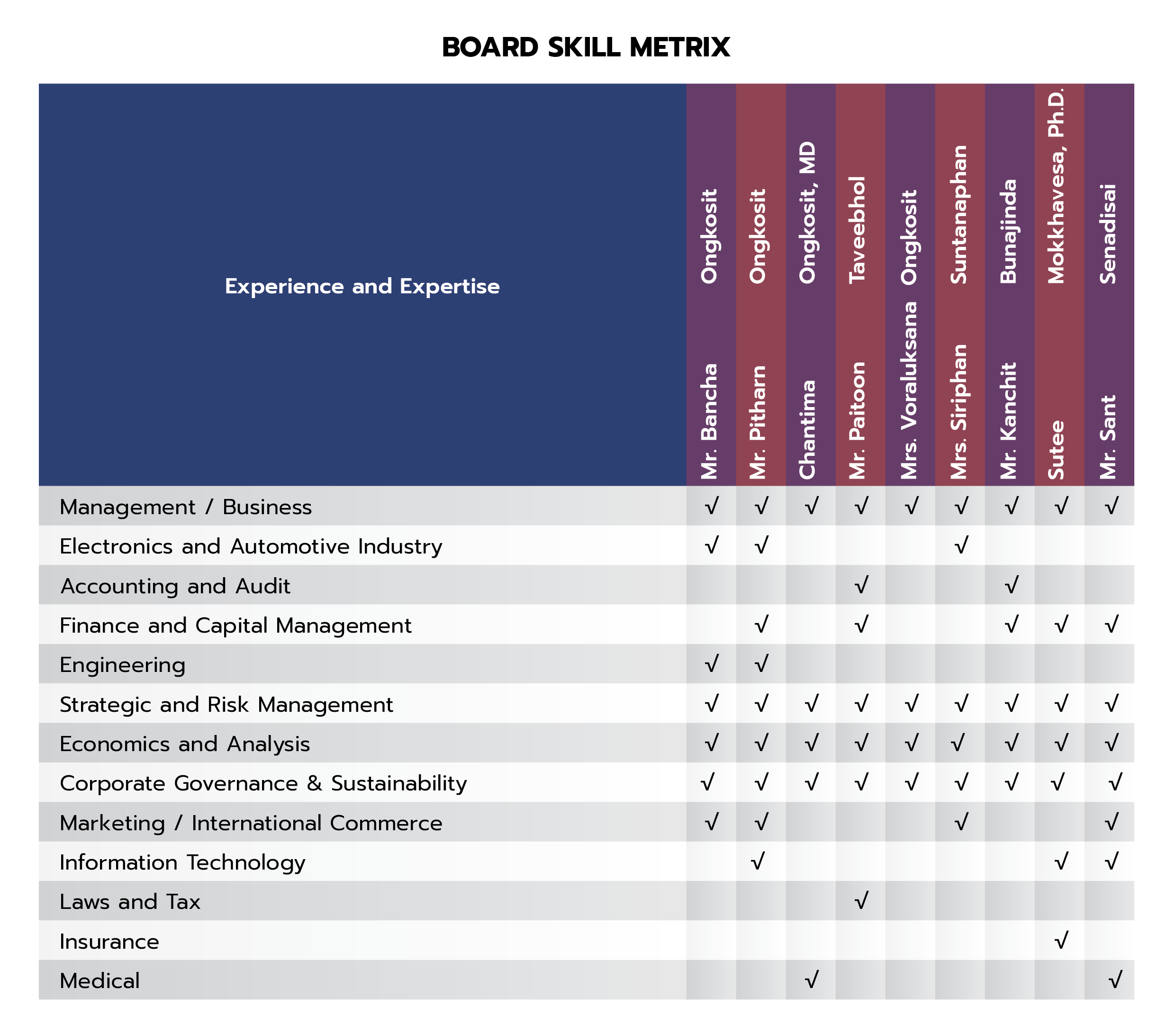
The Nomination and Remuneration Committee is responsible for selecting and screening candidates to hold the position of Director, with qualifications for comprising skills in areas such as finance accounting, industrial management, strategy, corporate governance, law and management, as well as the defined Board skill matrix which determines the required qualifications and other related criteria. The name of a candidate is proposing to the Board of Directors for consideration and approval before being submitted to the Shareholders’ Meeting for a vote in accordance with the following criteria and procedures:
Each Shareholder shall have one vote per one share.
Each Shareholder may exercise all votes for voting individuals nominated to be a Director, one person at a time.
Persons who receive the highest vote sequencing from higher to lower are elected to be a Director of the Company per the number required that year. In the case where the a vote is even for the last required Director making the number of Directors more than that required, the Chairman of the Meeting will cast the deciding vote.
When there is a vacancy for a Director due to other conditions rather than by rotation, the Board of Directors appoints a qualified person who meets the criteria as required by the Company’s articles of association to fill the position and attend the next Board of Director’s Meeting. The appointed Director will remain in office for the remaining term of the replaced Director.
The Company has implemented a policy to limit the number of listed companies in which a Director can hold the position of Director to not exceeding five listed companies.
Directors & Chief Executives — Introduction
Nomination of Management
Nomination of the CEO
The Executive Board primarily considers the selection of qualified persons who are deemed highly knowledgeable and capable and who possess a high degree of experience and understanding of the business. The Executive Board then proposes the candidate to the Nomination and Remuneration Committee to be put forward to the Board for approval.
Criteria for CEO Selection
The CEO must possess knowledge, skills, and management experience relevant to the company’s business. They should have expertise in areas beneficial to the company and aligned with its business strategy, without discrimination based on gender, age, race, etc.
The candidate should demonstrate leadership, vision, ethics, and a positive attitude towards the organization, dedicating sufficient time to contribute to the company’s operations.
Essential knowledge and skills for the CEO position:
3.1 Visioning and Strategic Planning
3.2 Planning and Organizing
3.3 People Management
3.4 Problem Solving and Decision Making
3.5 Change Management
The candidate must have a transparent work history and must not have any disqualifying characteristics as specified by the Securities and Exchange Commission (SEC)
Nomination of Executive management
The Board of Directors authorizes the Chief Executive Officer to select and appoint candidates with the qualifications, knowledge, skills and experience suitable for each executive position. The recruitment will be processed under the Company’s human resources procedure.
Succession Plan for Top Executive Positions
The Board stipulates the succession plan for the position of CEO and the Executive VP of all business Unit. The succession plan for the CEO and the top Executives of the Company is carried out by the Nomination & Remuneration Committee and propose to the Board of Directors. The process begins with the selection of candidates who possess the required qualifications, competency and experience for each position. The focus of the recruitment is also on young talent, as persons of this age group can be trained and developed to be future leaders. The Company implements performance-based Pay in line with the achievement to target, in order to maintain its employees and encourage them to grow together with the Company for the long term. In a long term, the Nomination and Numeration Committee must review and conclude the successor plan for the CEO and the executive management and report to the Board once a year.
Roles and Responsibilities of the Board of Directors and Chief Executive Officer
The Company has a clear separation of roles and responsibilities between the Company Directors and the chief executive officer in which the Director’s role is to monitor management’s performance in achieving targets and ensuring that there are systems in place to enhance the legal and ethical integrity of business operations. All Directors understand the responsibility of the Board of Directors and the business operations of the Company. They perform their duties with honesty and in good faith, using due care and diligence with regards to the highest benefits of the Company and the fair treatment of all Shareholders. They have to express their opinion independently and are completely dedicated to their duties. The role and responsibilities of the Board of Directors are provided in the “Management Structure” section.
The authority and duties of the Chief Executive Officer
The Chief Executive Officer has the authority and duties in respect to the management of the Company as assigned by the Board of Directors and shall manage the Company by strictly complying with the plan and budget as approved by the Board of Directors honestly, faithfully and carefully, and to protect the interests of the Company and shareholders include the following:
Supervising the business operations and/or general management of the Company.
Employing, appointing, removing, transferring, promoting, demoting, reducing salaries or wages, or taking disciplinary action against staff and employees, and, as required, summarily dismissing staff and employees.
Being authorized to approve the employment of executive management; Sr. Vice President, Vice President and Manager
Being authorized to direct, contact, instruct, take action, enter into legal acts, agreements, directives, notices or any letters in order to communicate with government agencies, state enterprises and other persons, as well as taking any necessary and appropriate action to complete the aforementioned interactions.
Giving approval or authorizing sub-agents to grant approval for the payment for the procurement of property and services for the Company’s benefit. The Managing Director’s authority to approve payment is limited to Bt800 million for normal commercial transactions and Bt400 million for procurement of other property. Payment exceeding the limit of the Managing Director’s approval shall be proposed for the approval of the Board of Directors.
Being authorized to approve the salary adjustment, bonus payment and adjust annual compensation for Management and employee
Directing the preparation and submission of the Company’s business policy, as well as business and budget plans for the approval of the Board of Directors, and reporting on the progress under the approved business and budget plans to the Board of Directors quarterly
Managing or undertaking business in accordance with the policy, business and budget plans approved by the Board of Directors and/or the Executive Committee.
Being eligible to authorize sub-agents and/or assign other persons to perform certain duties. Such authorization and/or assignments shall be subject to the extent of authorization under this Power of Attorney and/or in accordance with the regulations, rules or directives stipulated by the Board of Directors and/or the Company
Approving the appointment of the authorized signatory for checks or money-ordering documents of the Company, as well as agreements, accounting and financial documents and general documents.
Acting as management advisor in respect of the financial, marketing, human resources and other operational policies that involve the Company’s business operations.
Approving the appointment of advisors for specific tasks as required for the Company’s business operations.
Acting as the authorized person in managing the Company’s business, in all respects, in accordance with the Company’s objectives, rules, policies, regulations, codes of conduct, directives, resolutions of shareholder meetings and/or resolutions of the Board of Directors or Executive Committee.
Leadership and Vision
The Board of Directors provides leadership, vision and independent decision-making. It is responsible for overseeing Corporate Governance in order to optimize the benefits of the Company and Shareholders. The Board approves the Company’s vision, mission, business plan and annual operating budget, and monitors to ensure the business plan is followed in accordance with the approved budget to maximize the economic value added to the business and for the benefit of all stakeholders.
Policy to Appoint a Director or Management to be the Director of a Subsidiary/ Associate Company
In case the Company invests in a new subsidiary of an associate company, the Company will appoint a Company Director or member of Management to be the Director of such subsidiary/ associate company. This is for the purpose of streamlining management policy throughout the Group for efficient operational management and to create the most value-added for all stakeholders. Taking a position in another subsidiary company is considered part of the duty of Directors and Management.
Are Directors Selected Through the Nomination Committee?
Yes
Are Chief Executives Selected Through the Nomination Committee?
Yes
Rights of Minority Shareholders on Director Appointment
A shareholder who wishes to propose an item for the agenda or a candidate for director must be a shareholder of the Company on the date the shareholder proposes the agenda item or candidate for director. The shareholder making the proposal can be an individual or a group of shareholders holding a minimum of not less than 1% of the total number of voting right shares.
The Company provided an opportunity for shareholders to propose agenda items and nominate candidates for directorship during the period from September 4 to December 31, 2024 via company’s website, email, fax or the letter with details and guidelines published on the Company’s website www.kce.co.th. including publishing the right granting through the channel of the Stock Exchange of Thailand, to preliminarily screen before submit to the Board of Directors for consideration. The Shareholders are given the opportunity to submit questions related to the agenda of the meeting in advance. Finally no Shareholders proposed an agenda or nominated a person to consider or send the questions related to the meeting agenda.
Method of Director Appointment
| Method | Other — Please Specify |
|---|---|
| Other | It must be approved by a majority of the total number of votes cast by shareholders attending the meeting and casting their votes. The election of directors shall be considered individually. |
Selection of Independent Directors
Criteria for Selecting Independent Directors
The Company has defined the role and qualifications of the Independent Directors in compliance with the Securities and Exchange Commission’s and the Stock Exchange of Thailand’s criteria, as follows:
Shall not hold more than 0.5% of the total voting shares of the company, including the shares held by related persons of that independent director.
Is not or has never been a director involved in management, an employee, a staff member, a salaried advisor, or a person with controlling authority in the company unless at least 2 years have passed since leaving such positions.
Is not related by blood or by legal registration (e.g., parent, spouse, sibling, child, or spouse of a child) to any other director, executive, major shareholder, controlling authority, or a person nominated as a director, executive, or controlling authority of the company or its subsidiaries.
Has no current or prior business relationship with the company in a manner that might obstruct independent judgment. This includes not being or having been a significant shareholder or controlling authority of an entity that has a business relationship with the company unless at least 2 years have passed since such relationships ended.
Is not and has never been an auditor of the company and is not a significant shareholder, controlling authority, or partner of the audit firm where the auditor of the company belongs, unless at least 2 years have passed since such relationships ended.
Is not and has never been a professional service provider, including a legal or financial advisor who receives service fees exceeding 2 million baht per year from the company, nor a significant shareholder, controlling authority, or partner of that professional service provider unless at least 2 years have passed since such relationships ended.
Is not appointed as a representative of the company's directors, major shareholders, or shareholders who are related to major shareholders.
Does not operate or hold shares exceeding 0.5% of total voting shares in a business that is similar to and significantly competes with the company or its subsidiaries, nor is a partner in a partnership or a director involved in management, employee, staff member, or salaried advisor of such competing business.
Has no other characteristics that would impede the ability to express independent opinions on the company's operations.
Is capable of performing duties, expressing opinions, and reporting work outcomes independently, without being under the control of the company's management, major shareholders, or related persons, including close relatives of those individuals.
Did Any Independent Director Have a Business or Professional Relationship?
No
Director Development
Development of Directors in the Past Year
During the past year, the Board of Directors has emphasized the continuous development of directors’ competencies and understanding of their roles, duties, and responsibilities. The directors participated in various training programs, seminars, and knowledge-sharing sessions on topics such as corporate governance, risk management, sustainability, legal updates, and emerging economic trends that may affect the Company’s operations. These activities aim to enhance the Board’s effectiveness and ensure alignment with international best practices.
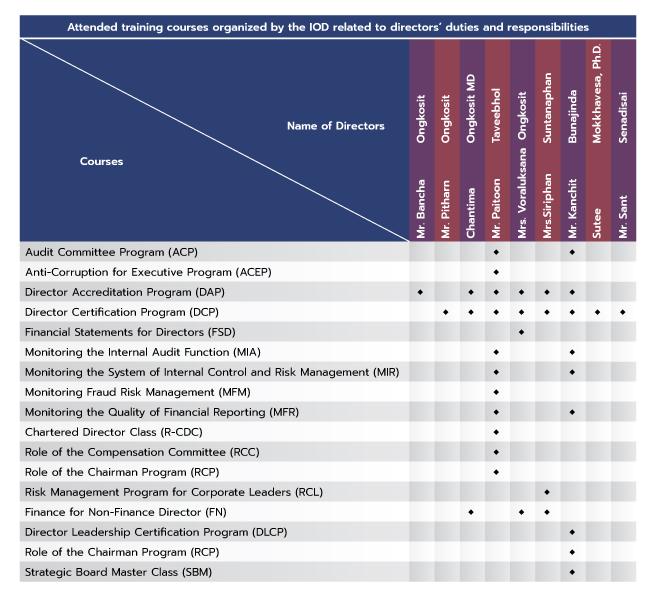
There were directors attending trainings with the Thai Institute of Directors Association (IOD) in courses related to their roles. 100% of the total board members participated, with the IOD courses as follows:
Directors Accreditation Program (DAP): 67% of the total board members
Directors Certification Program (DCP): 89% of the total board members
Qualifications for Director Selection — Introduction
The candidates for Director Nominees should possess the following qualifications:
1. Hold qualifications according to the Public Company Act, Securities and Exchange Act and the Good Corporate Governance of the Company. 2. Be knowledgeable, capable, independent and dedicated with the ability to perform the duties of a director with care and loyalty. Candidates should be able to attend Board of Directors meetings regularly, study meeting agendas in advance and productively participate in the meeting in a straightforward manner. 3. Have the skills and knowledge crucial to the business: accounting & finance, business management, business strategy, corporate governance and laws. 4. Should not hold more than three board positions if an executive director and not more than four board positions if a non-executive director in listed company. (refer to the definition). 5. Be not over 65 years of age on the election date. When elected, a director who becomes 65 can maintain his/her directorship until the expiry of his/her term. 6. Independence director must have general qualifications and specific skills, being independent from the group of major shareholders and have the full qualifications prescribed by the Capital Market Supervisory commission.
Evaluation of Board & Subcommittee Performance
Criteria for Evaluating Board Performance
The Board of Directors stipulates (1) a self-assessment of the Board; (2) a self-evaluation of individual Directors; and (3) a self-assessment of all 4 sub-committees (the Audit Committee, the Nomination and Remuneration Committee, the Corporate Governance and Sustainability Committee, the Enterprise Risk Policy Committee), in order that the Directors can jointly review their performances and jointly solve problems in order to ensure an overall improvement in performance.
Self-assessment of the Overall Performance of the Board
The Board has established a self-assessment for the overall performance of the Board of Directors. It serves as a tool to reflect the operational efficiency of the Board in accordance with the principles of Good Corporate Governance and to facilitate a regular review of the performance of the Board. The process aims to set a standard of practice for the assessment of the performance of the Board of Directors, which is conducted on an annual basis and led by the Chairman of the Board. The Board of Directors’ performance and accomplishments are reported in the annual report.
Self-assessment procedure - the entire Board
The Board reviews and approves the form and format used in the assessment.
In 2025, the Board endorsed using an evaluation form established by the SET and modified some questions to cover all areas of its responsibilities and to suit the characteristics and structure of the Company’s Board of Directors.
The Company’s Secretary concludes and analyses the assessment results of the Board's performance and reports the results to the Board.
The Company’s Secretary summarizes the results of the analysis and additional comments from the Board to develop an improvement plan.
The criteria of the self-assessment - The entire Board
Structure and Qualifications of the Board consisting of the diversification of Directors, independent director ratio and qualifications of sub-committee members.
Roles, duties and responsibilities of Directors, which consist of a sufficient time in considering important issues, transactions involving a conflict of interest, the internal control system and risk management.
The Board Meeting, which consists of arranging the meeting schedule for the entire year in advance, quality of documents for the Meeting that is sufficient for the Board’s decision-making.
Duties of Directors, which include a regular attendance of meetings and the opportunity to express opinions freely.
The relationship with management, which consists of an opportunity to discuss and jointly resolve problems.
The self-development of Directors and the development potential provided to executives, which consists of understanding roles, knowledge of the Company's business, the promotion of training for Directors and succession planning.
Self-assessment of the Performance - individual Directors
Self-assessment procedure – the individual Directors
The Board reviewed and approved the form and format used in the assessment in accordance with the criteria set by the Environmental, Social, Governance and Sustainability Development Committee.
Individual Directors completed the self-evaluation themselves, giving opinions regarding the roles of Directors, their independence, management structure, knowledge development and comments on the administration of the organization.
The Company’s Secretary concluded and analyzed the assessment result and reported said results to the Board to establish a development plan for individual Directors.
The criteria of the self-assessment – the individual Directors
The qualification of Directors, the Board’s diversity, performance of Directors.
Roles, duties and responsibilities: independence, expressing opinions, participating in activities, the internal control system, risk management and disclosure of information.
Meetings: meeting attendance, expressing opinions and studying the agenda before the meetings.
Providing other recommendations that are useful for management of the organization.
Self-assessment of the Overall Performance - the Subcommittees
All Subcommittees: The Audit Committee, the Nomination and Remuneration Committee, Corporate Governance and Sustainability Committee, and the Enterprise Risk Policy Committee conducted a self-assessment of their performances on a yearly basis. The results are used to improve their performances and to subsequently make the Board and the Company's operations more effective.
The Audit Committee
Assessed topics: - The overall performance of Directors
Review of Financial Reporting
Independence of Directors
Compliance with the law
The Committee's performance reported to the Board
The Nomination and Remuneration Committee
Assessed topics: - Qualifications of Directors
Independence of Directors
Structure and continued development plan for Directors
The Remuneration policy
Method/criteria for fair remuneration
The Corporate Governance and Sustainability Committee
Assessed topics: - The overall performance of Directors
The CG Policy and Code of Conduct
Anti-corruption measures
Follow-up compliance with the policy
Auditing compliance with the SET's regulations and related laws
The Committee's performance reported to the Board
The Enterprise Risk Policy Committee
Assessed topics: - The supervision and execution of risk management
Monitoring and assessment of the results
Stipulation of measures regarding risk management
The Committee's performance reported to the Board
5. Evaluation of the Performance of the CEO
The Board of Directors requires an evaluation of the CEO’s performance be conducted on a yearly basis against target and evaluation criteria that are linked to the successful carrying out of the Company’s strategic plans in order to appropriately determine his remuneration and incentive rewards.
The Board considered approving the use of an assessment form for the CEO based on a preliminary format set by the SET. At the end of the year, the Company’s Secretary will distribute an evaluation form to all Directors and to the CEO for his self-assessment. The results will be summarized and used for a potential development plan for the CEO.
The Company’s Secretary will gather and report the evaluation results to the Nomination and Remuneration Committee and the Board in order to determine an appropriate remuneration for the CEO
Evaluation of Board Performance in the Past Year
In 2025, the Company has conducted a performance evaluation of the Board of Directors to ensure that the Board effectively fulfilled its roles and responsibilities in accordance with good corporate governance principles. The evaluation covered key areas including policy formulation, oversight of management operations, meeting attendance and participation, constructive input, as well as monitoring and reviewing organizational performance.
The overall results indicated that the Board, its was excellent, demonstrating accountability, transparency, and a strong commitment to the best interests of the organization. The outcomes of the evaluation have been utilized as a basis for continuous improvement, with the aim of enhancing the Board’s effectiveness and strengthening good governance practices to support the Company’s sustainable growth in the future.
Evaluation Results
| Evaluated Body | Group — Carried Out? | Group — Grade / Average Score | Group — Grade / Full Score | Individual (Self-Assessment) — Carried Out? | Individual (Self-Assessment) — Grade / Average Score | Individual (Self-Assessment) — Grade / Full Score | Cross (Assessing Other Directors) — Carried Out? |
|---|---|---|---|---|---|---|---|
| Board Of Director | Y | The average score was excellent | Excellent | Y | The average score was excellent | Excellent | N |
| Audit Committee | Y | The average score was excellent | Excellent | Y | The average score was excellent | The average score was excellent | N |
| Other Subcommittee | Y | The average score was excellent | Excellent | Y | The average score was excellent | Excellent | N |
| Other Subcommittee | Y | The average score was excellent | Excellent | Y | The average score was excellent | Excellent | N |
| Other Subcommittee | Y | The average score was excellent | Excellent | Y | The average score was excellent | Excellent | N |
Subcommittees
Subcommittees — Introduction
The Board of Directors has established five sub-committees to closely monitor and oversee the Company’s operations and to regularly report to the Board of Directors. These sub-committees comprise the Executive Committee, the Audit Committee, the Nomination and Remuneration Committee, the Corporate Governance and Sustainability Committee, and the Enterprise Risk Management Policy Committee. The Board of Directors has clearly defined the duties and responsibilities of each sub-committee. All sub-committees have prepared and submitted reports on their performance to the Board of Directors. Details of the authorities and responsibilities of each sub-committee are provided in Attachments 7–9, Sub-Committee Reports, while the results of the performance evaluation are presented in Section 8.1, Summary of duty performance of the board of directors over the past year.
Subcommittees
| Results of the Subcommittee's Duty Performance | Meetings — Introduction |
|---|---|
In 2025, the committee held 4 meetings, which addressed key topics and details regarding various risk factors. The main points are as follows:
1) Strategic Risk 2) Operational Risk 3) Financial Risk 4) Emerging Risk 5) Information Technology Risk 6) Environmental, Social, and Governance (ESG) Risk
The Enterprise Risk Management Policy Committee will continue to oversee and monitor significant risk management results every quarter outcomes to ensure that risks are maintained at an acceptable level. This approach supports and enhances the organization's ability to achieve its objectives and goals | |
A summary report of the committee’s activities was presented to the Board of Directors as follows:
| In 2025, the Nomination and Remuneration Committee held two meetings. All committee members attended both meetings. |
The Committee remains committed to enhancing governance standards in alignment with international best practices. Key actions undertaken in 2025 include:
The Committee has established a strategic oversight framework to ensure that ESG considerations are embedded into the Company’s long-term value creation strategy. Significant achievements in 2025 include:
|
Meeting Attendance & Remuneration
Meeting Attendance — Sub-section Introduction
The Board collectively establishes the annual meeting schedule in advance, beginning at the end of the preceding year. In accordance with this schedule, Board meetings are held on the second Tuesday of each month.
The Secretary submits Meeting documents that can be revealed in written form or via electronic means without affecting the Company’s business operations to the Directors at least 5 days in advance for their consideration, together with invitation letters specifying the agenda, Meeting date, time and place. In emergencies, to protect the Company’s rights or interests, an appointment for such a Meeting through other methods could be given at shorter notice. Requests for more information could be obtained from the executive office. Members of the Board may also request additional agenda items for the Board’s monthly Meeting.
During each Meeting, the Chairman allocates enough time for discussion of each significant issue and encourages all Directors to express their ideas with the Company’s Secretary and legal department in attendance. Executives who are directly responsible for pertinent issues discussed during the Meeting could be invited to clarify and provide information. The Company’s attorney attended all of the Meetings, recorded the minutes, and managed all documents as well as gave advice to the Board of Directors and executives regarding compliance issues. Directors who have a vested interest in an agenda item must abstain from voting or from attending the Meeting. The Company requires a quorum of at least 2/3 of the board members present to make a decision. The regular Meeting time usage is one-two hours.
The Board considered the monthly results of operations report compared with the targets. The Board also regularly considers and acknowledges any changes in relevant laws, rules, and regulations related to the Company, including following up the operations report in order to conform with rules, regulations, and best guidelines.
The company organized a meeting held exclusively among non-executive directors without the presence of management, held on 13 August 2025, allowing them to discuss and exchange views independently. Following the meeting, key discussion points were summarized and reported to the Board of Directors as guidance for monitoring management’s performance more effectively. In addition, the Company held monthly Executive Committee meetings, with the majority of committee members attending unless urgent commitments prevented their participation. At each meeting, the Chairman of the Executive Committee presided over the session, ensuring thorough consideration of each agenda item and providing opportunities for all committee members to express their opinions and engage in discussion. Senior management also attended the meetings to provide clarifications and relevant operational information as needed prior to any resolutions being passed.
The Board of Directors has a policy prohibiting any director or executive who is a related party or who has a vested interest in the matter under consideration from attending the meeting or voting on that specific agenda item. The determination of whether an individual is considered a related party or an interested person is based on the conflict-of-interest reports submitted by all directors and executives, in accordance with the Board’s established policy. These reports are prepared to disclose any relevant interests to the Chairman of the Board and the Chairman of the Audit Committee.
Justification for Directors' Non-Attendance
Did not attend the meeting due to be sick.
Remuneration — Introduction
The Company’s policy on directors’ remuneration is established with fairness, transparency, and appropriateness, taking into account each director’s roles, duties, and responsibilities. The remuneration structure is determined based on the scope of work, expertise, experience, and the Company’s performance, as well as prevailing economic conditions. Directors’ remuneration is reviewed by the Nomination & Remuneration Committee and approved by the shareholders’ meeting to ensure independence and accountability. This approach aims to attract and retain qualified directors, motivate effective performance, and promote sustainable good corporate governance in alignment with the Company’s long-term objectives.
Types of Remuneration of the Board of Directors
At the 2025 Annual General Meeting of Shareholders, the shareholders' meeting resolved to approve the remuneration of company directors, Audit committee and Sub-Committee are as Monthly compensation fee, Meeting fee and Annual fee.
1. Monetary compensation
1.1 Directors' remuneration
| Monthly compensation | Meeting fee / Time | Annual fee |
The Chairman | 45,000 | - | 2,200,000 |
Director | 40,000 | - | 1,100,000 |
2.2 Compensation for sub-committee members
Position | Meeting fee / Time | Annual fee | |
Audit Committee | The Chairman Director | 40,000 35,000 | 560,000 480,000 |
Nomination & Remuneration Committee | The Chairman Director | 30,000 25,000 | - - |
Enterprise Risk Policy Committee | The Chairman Director | 30,000 25,000 | - - |
Corporate Governance and Sustainability Committee | The Chairman Director | 30,000 25,000 | - - |
Non-Executive Director Committee | The Chairman Director | 30,000 25,000 | - - |
2. Other Remunerations : None
Remuneration or Benefits Payable to the Board
| Metric | Amount (Baht) |
|---|---|
| Remunerations or benefits pending payment to the board of directors over the past year (baht) | 0 |
Supervision of Subsidiaries & Associated Companies
Does the Company Have Subsidiaries or Associated Companies?
Yes
Is There a Mechanism for Overseeing Subsidiaries and Associated Companies?
Yes
Mechanism for Overseeing Management of Subsidiaries
The Company recognizes the importance of governing its subsidiaries and joint ventures to ensure aligned operations, adherence to sound corporate governance principles, and the protection of shareholder and stakeholder interests. To this end, the Company has established the following guidelines:
Governance Policy and Framework
The Company has established a governance policy and framework for subsidiaries and joint ventures to ensure that business operations comply with applicable laws and regulatory requirements. The framework defines the approval authority for significant transactions and sets out appropriate risk management practices.
Appointment of Directors and Executives
The Company appoints representatives with the requisite knowledge, skills, and experience to serve as directors in subsidiaries and joint ventures. These representatives are responsible for providing close oversight of operations and offering guidance on policy and management matters.
Performance Monitoring and Reporting
Subsidiaries and joint ventures are required to report regularly on operational performance, financial status, and related-party transactions. This enables the Company to monitor, evaluate, and manage risks across the Group effectively.
Internal Control and Risk Management
Subsidiaries and joint ventures are required to implement adequate internal control and risk management systems covering operational, financial, and legal compliance areas. This ensures that operations are transparent, auditable, and consistent with good corporate governance practices.
Disclosure of Material Information
Oversight Mechanisms
| Mechanism |
|---|
| Sending representatives to act as directors, executives or controlling persons in proportion to shareholdings |
| Defining the scope of powers, duties and responsibilities of directors and executives who represent the company in setting important policies |
| Disclosure of financial information and operating results |
| Transactions between the Company and related persons |
| Other important transactions |
| Acquisition or disposal of assets |
| Internal control system of the subsidiary operating the core business is appropriate and sufficient in the subsidiary operating the core business |
Board Duty Performance — Overview
Board Duty Performance — Overall Description
The Board is determined to lead the business successfully and to create the greatest benefit for Shareholders according to the Company’s vision and mission while considering business ethics, future risks and good governance. In this regard, the Board uses independent judgment and discloses important information to Shareholders and investors correctly, completely, fairly and timely.
In 2025, the Board continued to undertake the following activities:
Establish the Company’s Policy and Business Direction
The Board joined with management in establishing and reviewing the Company’s vision, mission, strategies, operation budget and business plan in each year. The Board also discussed with management regarding the operation plan, investment plan, dividend payment plan, as well as any problems, and monitored management’s performance according to the preset target in Board Meetings that are scheduled once a month, or 12 times per year. In 2025, a total of 14 Board of Directors meetings were held due to special agenda items concerning the consideration of overseas business acquisitions.
Promote Corporate Governance
To promote the efficiency in the practice of Corporate Governance, the Board:
Endorsed an action plan on CG and Anti-corruption for the year 2025, together with the annual goals for cascading the plan to all for implementation.
Encouraged the distribution of Corporate Governance Policy, business ethics and a code of conduct.
Reviewed and updated the corporate governance and code of conduct handbook.
Had all subcommittees and the CEO conduct a self-performance appraisal.
Established a channel for claims and suggestions on any matter so that employees and stakeholders could express their opinions independently, which led to improvements.
Oversaw the Environmental, Social, Governance and Sustainability Development Committee in reviewing, adjusting, assessing and updating Corporate Governance principles and business ethics consistent with the law, regulations of the SET and SEC, and good practices of international standards, and reported such compliance to the Board.
Designated the Internal Auditor unit to take role of the "Compliance Unit", and directly reported to the Audit Committee.
Determined the policy of CSR and sustainability development.
Foster necessary risk management and continuously followed up the results through the Enterprise Risk Policy Committee’s Report as in quarterly.
Review the management plan of the Risk Management Committee's risk mitigation plan.
Set is a policy to allow non-executive directors and independent directors organize their own meeting without the participation of management at least 1 time per year.
Oversight the preparation of practical guidelines for anti-corruption policy, and promote communication regarding an anti-corruption measures through all subsidiaries in the group.
Encourage all Directors and management to attend various seminars or courses, which would be beneficial to perform their duties.
Conduct an internal control self-assessment by related management, then reviewed by the Audit Committee and propose the result to the Board.
Review the policy and criteria in regard to the nomination and remuneration for directors and executive, including selection procedure remuneration structure and criteria's for the determination of compensation, in line with their duties and responsibilities, as recommended by the Nomination and Remuneration Committee.
The Nomination and Remuneration Committee revise the Committee’s Charter once a year.
Continue to improve the Annual Meeting of Shareholders. As a result, the Thai Investors Association and the Stock Exchange of Thailand rated the Company’s AGM that was an “Excellent” level.
The Board has committed to place importance in conducting business within the framework of Good Corporate Governance. As a result, the Company achieved an "Excellent” corporate governance score in the 2025 annual survey by the Thai Institute of Directors Association (IOD)
Assess the Board of Directors’ performance (overall and individual) with “excellent” outcome for the year.
Audit Committee Duty Performance
Audit Committee Duty Performance — Introduction
The Board of Directors appointed the Audit Committee to support the Company’s corporate governance oversight. The Board appointed Mr. Paitoon Taveebhol, an independent director with expertise in accounting and finance, to serve as Chairman of the Audit Committee. The roles and responsibilities of the Audit Committee are outlined in Section 2.2 Risk Factors and Risk Management – Risk Management Structure
Results of the Audit Committee's Duty Performance in the Past Year
In 2025, the Audit Committee held a total of 5 meetings. 4 of these were joint meetings with the Company’s external auditor, and on 1 occasion, the Audit Committee met with the external auditor without the presence of management.
The Audit Committee performed its duties and responsibilities in reviewing the financial statements, key accounting policies, and financial reports to ensure that the Company’s financial reporting was prepared in accordance with the accounting standards prescribed by the Federation of Accounting Professions, and that the information presented was accurate, complete in all material respects, and reliable. The Audit Committee also ensured that the Company’s accounting policies were reasonable and that significant information was adequately disclosed.
The Audit Committee reviewed the audit reports issued by both the Internal Audit Department and the external auditor regarding the assessment of the internal control system. It also reviewed the Company’s risk management and corporate governance practices to ensure that the internal control and risk management systems were adequate and appropriate.
In addition, the Audit Committee considered the independence of the Internal Audit Department; oversaw compliance with the Company’s Anti-Fraud & Corruption Policies; reviewed related-party transactions or transactions that may involve conflicts of interest to ensure compliance with applicable laws and the requirements of the Stock Exchange of Thailand; monitored compliance with securities and exchange laws, regulations of the Stock Exchange of Thailand, and other relevant laws governing the Company’s business; and reviewed, selected, and recommended the appointment of the Company’s external auditor.
In performing its duties regarding the consideration, selection, and appointment of the Company’s external auditor, the Audit Committee evaluates the auditor based on performance, scope of work, relevant experience, professional competence, reliability, the adequacy of resources, audit workload, independence, as well as approval by the Office of the Securities and Exchange Commission (SEC). The Audit Committee then submits its recommendation to the Board of Directors and the Shareholders’ Meeting for consideration and appointment of the external auditor.
The Audit Committee shall convene at least 4 meetings per year in accordance with the financial reporting cycle. The Chairman of the Audit Committee may call additional special meetings as necessary to consider matters that require joint discussion. In 2025, the Company held a total of 5 Audit Committee meetings.
Executive Committee Duty Performance
Results of the Executive Committee's Duty Performance in the Past Year
During the year 2025, the Executive Committee held a total of 12 meetings. The Committee performed its duties in accordance with the authority delegated by the Board of Directors, including setting management policies, formulating the Company’s business plans and annual budget, and exercising management authority as assigned. The Committee also monitored and reviewed the implementation of the Company’s policies and business plans to ensure efficient and effective operations. In addition, the Committee considered the feasibility of new investment projects and regularly reported the Company’s operating performance to the Board of Directors. The Committee further carried out other duties as prescribed in its Charter and ensured that the Company’s operations were conducted in compliance with applicable laws, rules, and regulations.